
Import fidelity
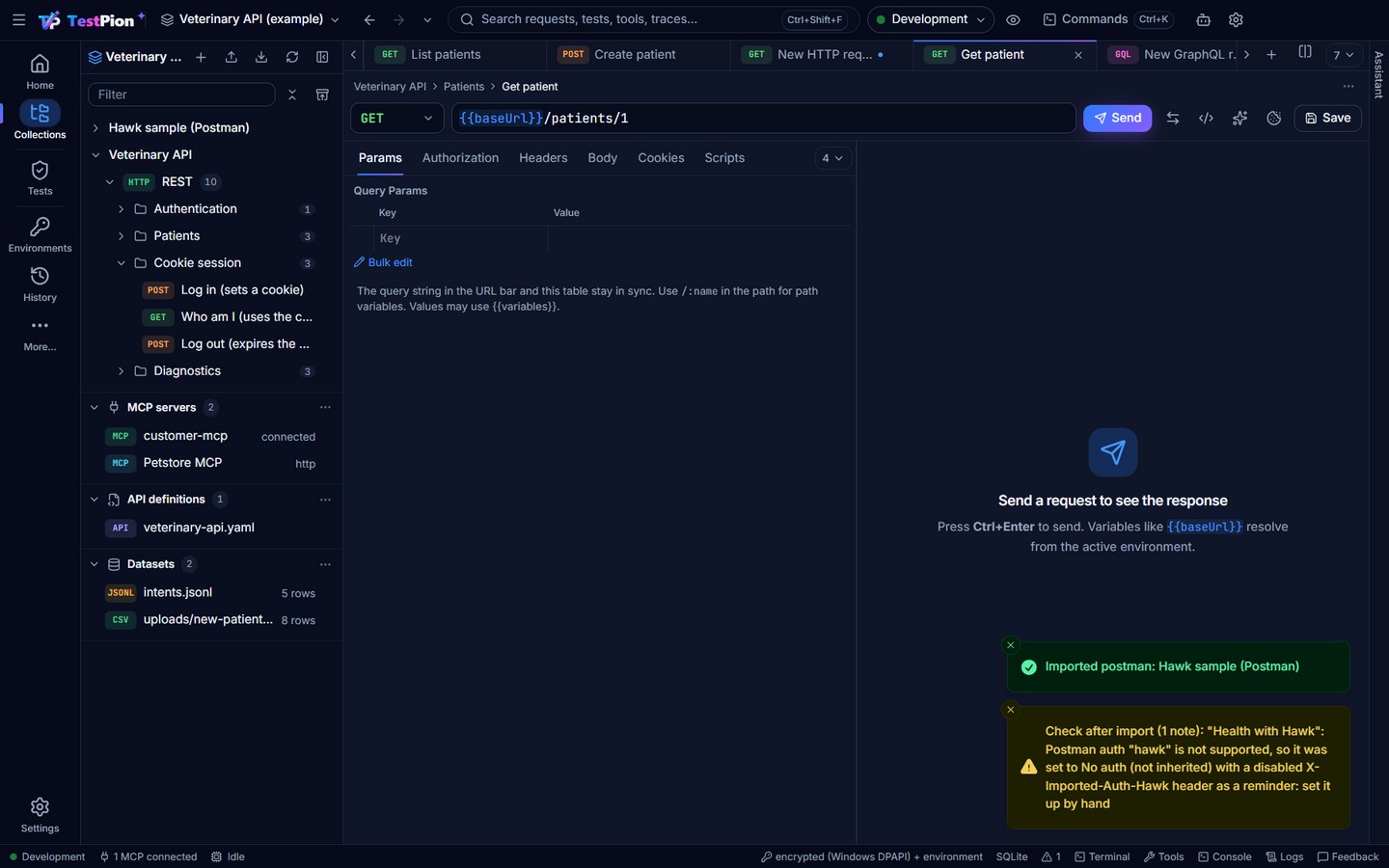
An import never drops something silently: whatever does not map one to one is a note that names the request or folder. The notes appear after the import (Check after import in the app, the first ones with and N more), under the result of testpion import (up to 20; --json lists them all in notes) and in the MCP tool import_definition (notes). How to import: Collections.
What each importer maps
| From | Comes over | Becomes a note |
|---|---|---|
| Postman v2.0 / v2.1 | Folders, requests, params, headers, bodies, auth, variables, scripts (pm.* → tp.*), saved responses, descriptions | An auth scheme TestPion doesn't have, an OAuth 2 grant it doesn't run, a JWT sent as a query parameter |
| Insomnia v4 JSON, v5 YAML | The same, plus environments (base merged into each), request and folder scripts (insomnia.* → tp.*), template tags, gRPC and WebSocket requests (v4) | Folder headers (added to each request inside), template tags without an equivalent, insomnia.parentFolders and other APIs TestPion lacks, v5 gRPC / WebSocket / Socket.IO / MCP items, design documents, unit tests, cookie jars |
Bruno folder, export or .bru file | Folders, requests, params, headers, bodies, auth, variables, environments, assertions, docs, scripts (bru.* → tp.*), the collection's .env | Secret values to enter again, .env names without a value, bru.* calls TestPion lacks, gRPC / WebSocket requests, unsupported body types |
| Hoppscotch | Folders, requests, params, headers, bodies, auth | Scripts (pw.*, kept as comments), unsupported auth |
GraphQL schema (.graphql, .gql) | A GraphQL request for {{graphqlUrl}} with an operation for the first Query field; the schema in specs/graphql/ | Where to set the endpoint; a schema that does not build |
Auth
A scheme TestPion has (basic, bearer, API key, digest, OAuth 1, OAuth 2, AWS Signature, JWT HS256/384/512) comes over as that auth. A scheme it doesn't have (Hawk, NTLM, Akamai EdgeGrid, ASAP, WSSE, netrc, a JWT signed with RS256 …) is never inherited from the folder: the request gets No auth, a disabled header such as X-Imported-Auth-Hawk: needs manual setup, and a note. Set the auth up by hand (or send the header your API expects) before you run it.
Insomnia template tags
| Tag | In TestPion |
|---|---|
{% uuid %} | {{$guid}} |
{% now 'iso-8601' %}, 'millis', 'unix' | {{$isoTimestamp}}, {{$timestampMs}}, {{$timestamp}} |
{% timestamp %} | {{$timestampMs}} |
{% faker 'randomFirstName' %} | {{$randomFirstName}} (the same names as Postman's dynamic variables) |
{% base64 … %}, {% hash … %}, {% now 'custom', … %} | A line of the request's pre-request script that sets a variable, used in its place |
{% response 'body', 'req_…', '$.token' %} | Chained: the referenced request's post-response script sets {{insomnia_<request>_<field>}}, which this request uses. Send that request first (Insomnia did it on its own). Headers, the raw body and the URL chain the same way |
{% prompt %} | {{prompt_<label>}}: set it in an environment |
Any other (cookie, os, file, jsonpath, request, plugins, a JSONPath with filters) | Left as text, with a note naming the request |
{{ _.name }}, {{ _['a-b'] }} and {{ name }} become {{name}}.
Bruno scripts and .env
Bruno's bru.* calls are written with TestPion's API: bru.getEnvVar / setEnvVar → tp.environment.get / set, bru.getVar → tp.variables.get, bru.setVar → tp.collectionVariables.set (it lasts for the run, like Bruno's), bru.runner.setNextRequest → tp.execution.setNextRequest, bru.getProcessEnv → tp.variables.get. req, res, test and expect run as in Bruno. A call TestPion lacks (bru.sendRequest, bru.cookies …) would fail when run: it gets a // TODO(import) line above it and a note. Export ▸ Bruno collection folder writes the scripts back with bru.*.
The collection's .env file (only .env; .env.example and the like are not read) becomes secret variables of a Bruno .env environment and of each imported environment: {{process.env.API_KEY}} is {{API_KEY}}, and the values go to the secret store, never into workspace files. A name used but not set is listed as values needed. testpion import has no secret store, so it lists the names under Secret values were not saved: set them in the app, or as TESTPION_SECRET_* variables for the CLI (Secrets).
What to check by hand
- Requests with an
X-Imported-Auth-…header (unsupported auth). - Notes about template tags left as text, and chained variables: run the source request first.
- Scripts with
// TODO(import). - Values needed: secret variables to fill in (Bruno secrets,
.envnames). - Folder headers that were added to each request (TestPion folders have no headers yet).