
Examples workspace
TestPion comes with a TestPion Examples workspace. It opens the first time you start the app, and you can open it again at any time from Help ▸ Open Examples Workspace or the link on the Home page. Everything in it works against free public services, with nothing to install or configure. Select the Public APIs environment (it is selected for you) and press Send.
The workspace is copied into your data folder once. You can change it freely: app updates never overwrite your copy. They only add the examples that are new in that version and, when an older version left a second copy of an example collection (two Live streams (SSE), say), merge it back into one; the copy stays in Recently deleted for 30 days.
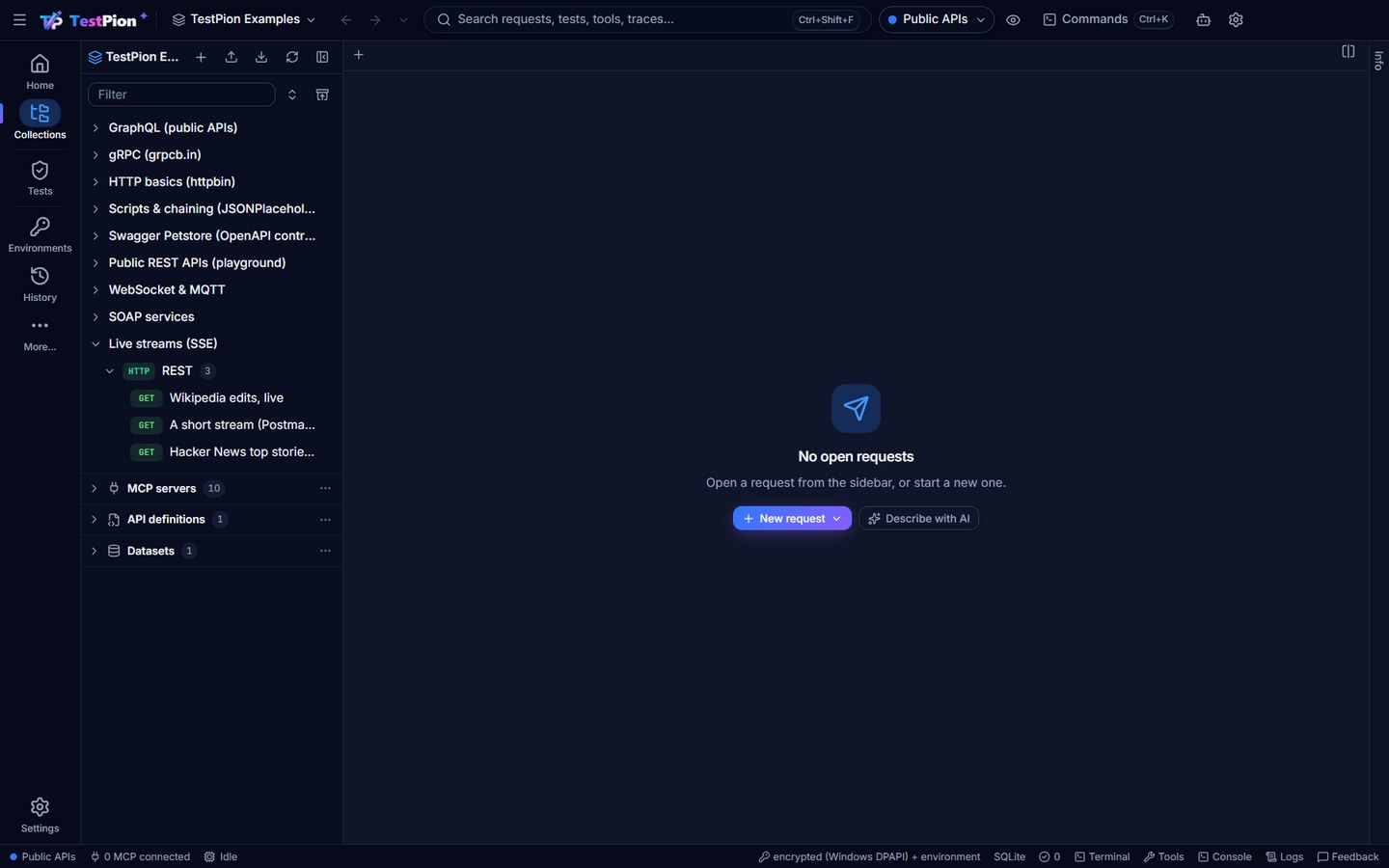
What's inside
| Area | Where | Uses |
|---|---|---|
| REST basics: methods, query parameters, JSON and form bodies, headers, redirects, XML, images, JSON Schema checks | Collection HTTP basics (httpbin) | httpbin.org |
| Authentication: Basic, Bearer, Digest, API key; cookies | Same collection, Authentication and Cookies folders | httpbin.org |
Scripts and chaining (tp.*), path variables, a tp.visualizer table | Collection Scripts & chaining (JSONPlaceholder); run it in order | JSONPlaceholder |
OpenAPI contract testing (openapi check against specs/petstore.json) | Collection Swagger Petstore (OpenAPI contract) | Swagger Petstore |
| A playground of public REST APIs: a login that returns a JWT used as a Bearer token; a full create, read, update, delete flow with a token in a cookie; an API key header; every method, Basic auth, any status code, slow responses; pagination, search, errors, images and open data | Collection Public REST APIs (playground); run a folder in order (▶) to see values flow between requests | DummyJSON, Restful-Booker, Postman Echo, ReqRes, Fake Store, Open-Meteo, PokéAPI, Open Library, GitHub, xkcd, Dog CEO, catfact.ninja, agify.io, Zippopotam.us, randomuser.me |
| GraphQL queries with variables, mutations, and an error case | Collection GraphQL (public APIs); open a request and press Introspect to browse the schema | Countries, Rick and Morty, Star Wars (SWAPI), GraphQLZero (mutations), AniList, PokéAPI GraphQL |
| Server-Sent Events: a short stream that ends, and live ones | Collection Live streams (SSE); press Stop when you've seen enough | Postman Echo, Wikimedia EventStreams, Hacker News (Firebase) |
gRPC through server reflection (no .proto files): unary, server streaming, plain text and TLS, every field type, metadata, a chosen error status | Collection gRPC (grpcb.in); tests in Tests ▸ grpc/ | grpcb.in |
| WebSocket echo | Collection WebSocket & MQTT ▸ Echo servers; tests in Tests ▸ websocket/echo.yaml | Postman echo, echo.websocket.org, ws.ifelse.io |
| MQTT publish and subscribe | Collection WebSocket & MQTT ▸ MQTT brokers; test in Tests ▸ websocket/mqtt.yaml | test.mosquitto.org, HiveMQ, EMQX |
SOAP, imported from a WSDL (1.1 and 1.2; tests read the XML with xml2Json), a calculator and country information | Collection SOAP services | DataAccess NumberConversion, dneonline calculator, oorsprong CountryInfo |
| MCP over Streamable HTTP, no account | MCP servers ▸ Public servers (Petstore MCP, DeepWiki, Hugging Face Hub) and Docs & search (Microsoft Learn, Context7, Cloudflare, Astro, the MCP spec through GitMCP); tests in Tests ▸ mcp/ | petstore.run.mcp.com.ai, mcp.deepwiki.com, huggingface.co/mcp, learn.microsoft.com/api/mcp, mcp.context7.com, docs.mcp.cloudflare.com, mcp.docs.astro.build, gitmcp.io |
| MCP over stdio, every MCP feature (tools, resources with subscriptions, prompts, completions, logging, long-running progress) | MCP servers ▸ Reference servers ▸ Everything; needs Node.js (it starts npx -y @modelcontextprotocol/server-everything) | the official reference server |
| MCP mock (offline) | MCP view ▸ Weather (offline mock), from mocks/weather.mcp-mock.yaml | none |
| AI prompts: JSON output, summaries, a prompt injection | AI Lab ▸ Saved prompts | the offline demo model |
| Evaluation over a dataset, safety, RAG, an agent that calls MCP tools | Tests ▸ ai/, agent/ | the offline demo model (+ Petstore MCP for the agent) |
| Test suites | Tests ▸ All examples (everything) and Offline (no internet needed) | |
| Monitor (paused) | Monitors ▸ Public APIs health | httpbin.org |
| Traces | Traces view: every request, MCP call, model call and test run adds one |
The offline demo model
AI examples use Offline demo model, a deterministic stand-in that runs inside TestPion. It classifies the example intents, refuses the prompt injection, answers the RAG question and calls the Petstore MCP tool. It is set up in AI Lab ▸ Providers, with rules (regular expression → reply or tool call) in its x-mock-rules header. So evaluations, safety tests and the agent test run without an API key and give the same result every time.
To try a real model, add an API key to OpenAI, Anthropic or Google Gemini under AI Lab ▸ Providers, or start Ollama locally. Then pick that provider in AI Lab, or change provider: in a test file.
From the terminal
The same workspace is in the repository at examples/public-workspace, so the CLI and AI agents can use it too:
testpion run -w examples/public-workspace --suite all      # everything (needs internet)
testpion run -w examples/public-workspace --suite offline  # no internet needed
testpion run-collection "HTTP basics (httpbin)" -w examples/public-workspace -e "Public APIs"
testpion grpc grpcb.in:9000 hello.HelloService/SayHello -d '{"greeting":"hi"}'
testpion run-collection "Public REST APIs (playground)" -w examples/public-workspace -e "Public APIs"
testpion mcp --url https://petstore.run.mcp.com.ai/mcp
testpion mcp -- npx -y @modelcontextprotocol/server-everything
Public services
These are free services run by other people. They can be slow, rate-limited (the GitHub API allows 60 requests an hour without a token), or down for a while, and shared ones such as the Petstore change as other people use them. A failure in the examples is not always a TestPion problem. For tests that must be stable, use your own API or a mock server.